Showing posts with label Midewin National Tallgrass Prairie. Show all posts

Sunday, 30 October 2011

Black Locust Savanna at Iron Bridge Prairie

Black Locust savanna

The savannas in the prairie region mainly consist of Bur Oak, Quercus macrocarpa, but here at the Iron Bridge Prairie at Midewin it is a small savanna or rather open woodland of Black Locust, Robinia pseudoacasia.

The Black Locust is a lovely tree with ornamental branches and a open, loose crown with a scanty leafage that allow some light to pass to the ground and permit a rich understory of grasses and forbs.


The Iron Bridge Prairie at Midewin is fairly new. The restoration of the prairie that once existed here began as late as in 2009. This text is partly taken from an information sign at the prairie. Thanks to many years of cultivating rowcrops as corn and soybeans the soil was rather free from weeds.

Two years ago Midewin staff and volunteers spread 1000 pounds of prairie seeds from 98 different species. This was followed by the planting of 5000 prairie plant plugs.

The first plants to flower are the pioneer plants with rapid growth as Yellow Coneflower, Ratibida pinnata and Wild Bergamot, Monarda fistulosa. They benefit from disturbance and have their best development some few years afterwards.

It will take several years for the majority of the prairie plants to establish their root systems and grow in numbers to out-compete invasive, weedy species.

 
Like a yellow lake of Coneflowers

Monarda and Ratibida are pioneer members of the prairie ecosystem 

Monarda fistulosa, Ratibida pinnata and Coreopsis tripterris

The path through the Black Locust Savanna

Saturday, 29 October 2011

Midewin National Tallgrass Prairie

The Royal Catchfly, Silene regia

The Midewin National Tallgrass Prairie is a prairie reserve of about 78 km2 (19,000 acres) of land. It is located on the site of the former Joliet Army Ammunition Plant near Elwood south of Chicago in Illinois.

At the headquarter along the road the Welcome Center is surrounded by plantings of different prairie plants you will be able to find at a tallgrass prairie. Inside the building you can get information about suitable walking trails, buy books and learn about the prairie ecosystem from informative posters.

I decided to take the Grass Frog Temporary Trail and indeed I met a lot of frogs along the path. But fist I visited the seed production fields close to the parking area. There I directly already from long distance discovered the bright red Royal Catchfly, Silene regia. It is a very showy slender, upright plant with unbranched stems and glowing red flowers. The Royal Catchfly is rare in nature, but here i captured it growing at the seed beds.

Other plants cultivated for seed production at Midewin were among others Pale Indian Plantain, Arnoglossum atriplicifolium, Rattlesnake Master, Eryngium yuccifolium, Compass Plant, Silphium laciniatum and Prairie Dropseed, Sporobulus heterolepis.

The Welcome Center with prairie plantings

Inside the Welcome Center


If you look closer to the sign above you'll see the yellow area at the small map in the center. Yellow here indicates the pre-settlement extent of prairie habitat around the year 1920. Today most of this land is converted into corn fields or human infrastructur. 

Pale Indian Plantain, Arnoglossum atriplicifolia

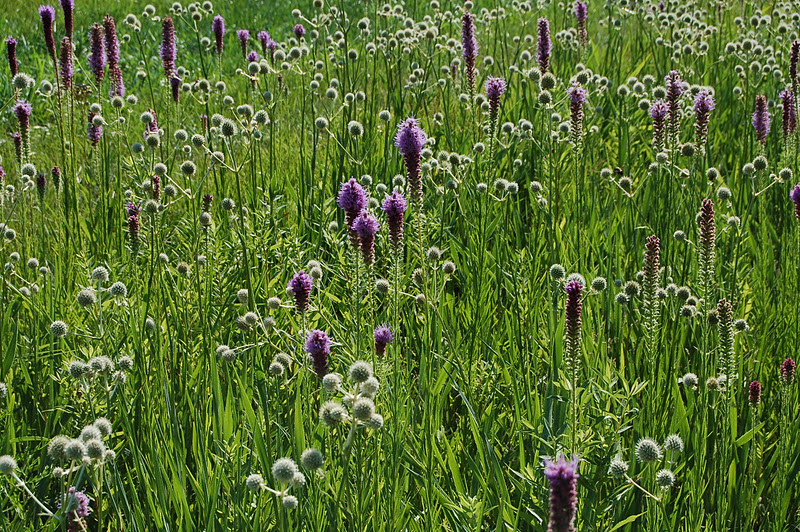
Eryngium yuccifolium and Liatris pycnostachya

Seed production of Royal Catchfly, Silene regia

Yellow Coneflower, Ratibida pinnata, at the Grass Frog Temporary Trail

Rudbeckia subtomentosa and Eryngium yuccifolium along the trail

Rudbeckia subtomentosa