Showing posts with label Wisconsin. Show all posts

Monday, 30 January 2012

The Prairie Nursery


The Show Garden at The Prairie Nursery

Last year I made a prairie tour to Illinois and Wisconsin for three weeks and now I am planning another trip to U.S.this summer. Maybe I'll start with the 30th Perennial Plant Symposium in Boston, Massachusetts and then continue to Chicago. This time my plan is to drive through Illinois to Kansas and then back to Chicago through Missouri and to make interesting stops here and there along the road.

Of course it is the world's last and only preserved prairie landscapes that attracts, the Flint Hills of Kansas. There one can view large herds of bison and rolling prairies as far as the eye can see. But before we go deeper too much into the forthcoming trip, I'd like to tell you something from a visit to The Prairie Nursery in Westfield, Wisconsin, I visited last summer, the first week of August.


Neil Diboll shows me the difference between the species of Vernonia

The Prairie Nursery is run by Neil Diboll, a highly skilled grower and an internationally recognized pioneer in the use of native North American Prairie plants in gardens and landscapes. Neil is also a very talented and entertaining lecturer and I have earlier been privileged to listen to his lectures in both Alnarp in Sweden and Weinheim, Germany.

I have previously bought seeds from The Prairie Nursery to my landscaping projects in Alnarp, Laholm and Mariestad, and was therefore particularly interested in meeting Neil and his staff and to see how the nursery looked like.

Thousands upon thousands of small prairie plant seedlings in the greenhouse

After looking around in the office, we drove to the nursery where Neil first showed me the modern greenhouse, where nearly everything was controlled automatically, but the monitoring of the small, scrawny seedlings were handled manually of course.

Part of the model gardens at The Prairie Nursery in Westfield

At the nursery they have created several small model gardens with different themes. Here were, for example, a butterfly garden, a healing garden and a deer resistent garden. The prairie plants were planted in beautiful combinations in each garden plot and just at my visit, nearly all the plants appeared to be at their absolute peak development. It was clear that I had managed to hit on the right week for my stay, at least regarding the amazing flower display.

Agastache foeniculum, Monarda fistulosa and Ratibida pinnata

Liatris and Parthenium integrifolium

Neil Diboll and Peter Gaunitz outside the office. Photo: Sarie Doverspike

Thursday, 22 December 2011

Madison Arboretum


One of the first days of August this year I visited The University of Wisconsin Arboretum in Madison.There is so much to see here and very excited, I stopped already directly at the entrance to the park at a colorful prairie planting with Yellow Coneflower, Ratibida pinnata, Sweet Coneflower, Rudbeckia subtomentosa, Culver's Root, Veronicastrum virginicum and Pale Indian Plantain, Arnoglossum atriplicifolium, among other prairie species.

Steve Glass is telling me about the Curtis Prairie

At the Visitor Center I met Steve B. Glass who showed me around and was my excellent guide the whole day. Steve is as restoration ecologist responsible for the restoration planning and the fire management at the University of Wisconsin-Madison Arboretum where he has been active in all phases of prairie restoration since the late 80s.

Steve showed me first the Native Plant Garden and then we walked out on the Curtis Prairie and studied the dynamics of prairie vegetation. My guide turned out to be a skilled prairie ecologist and since he was both pleasant and accommodating, we had a very fruitful day in the great outdoors.

Afterwards, Steve gave me even a bag full of interesting material and a book on plants at Madison Arboretum, which I had great pleasure from.


A colorful prairie planting already at the entrance to the Arboretum.

Yellow Coneflower and Pale Indian Plantain at the entrance

Eupatorium purpureum in the dry shade beneath a Bur Oak

Purple Coneflowers, Echinacea purpurea, at the Curtis Prairie

Curtis Prairie is the oldest restored prairie in North America and occupies about 60 acres of land. It is a deep-soil tallgrass prairie with a huge diversity of prairie plants. In July and August the Liatris, Monarda and Echinacea provide for the greatest color display and in early fall it is the grasses and the sumacs who excel in the most brilliant fall colors. The Smooth Sumac, Rhus glabra, grows scattered almost everywhere on the Curtis Prairie and spreads by underground runners. In autumn the leaves turn deep scarlet red with less orange tints compared to Rhus typhina


Ironweed and Yellow Coneflower at the edge of the Curtis Prairie

The Curtis Prarie with Liatris and Eryngiym yuccifolium 


Along the path to Greene Prairie we passed through a small woodland with dry, sandy soil. Here we found many drought tolerant species as Plantain-leaved Pussytoes, Antennaria plantaginifolia, and the Silver Sage, Artemisia ludoviciana, growing among the patches of Smooth Sumac.

Big leaves of Prairie Dock, Silphium terebinthinaceum at Greene Prairie 


Steve discoverd a hybrid between Compass Plant, Silphium laciniatum and Prairie Dock, Silphium terebinthinaceum with intermediate leaves growing at Greene Prairie

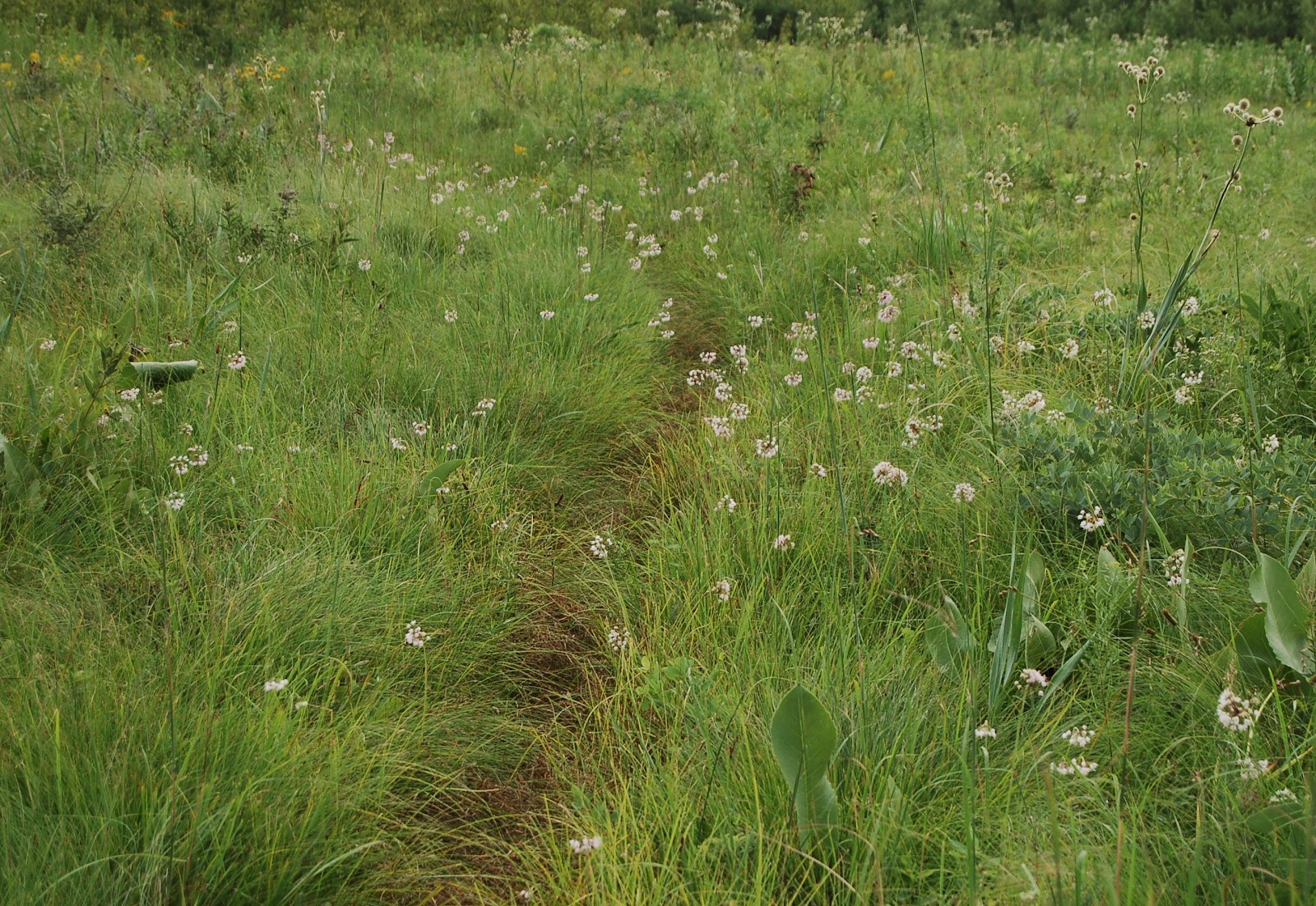
Nodding Onion, Allium cernuum, along the track


Wednesday, 2 November 2011

Northwind Perennial Farm

Roy Diblik at the entrance to the show gardens

On the way to Madison we visited Northwind Perennial Farm near Lake Geneva in Wisconsin and Roy Diblik showed us around in the show gardens and the garden shop. Roy Diblik is a devoted perennial grower with a big range of native prairie plants in his assortment.

He is also creating natural plantings and in Millennium Park I adored his yellow tallgrass prairie near the Art Institute of Chicago. I like that Roy is using a method of planting similar to my way of doing it. He makes informal groups or natural mixtures of plants far from the old fashioned block system still used by most garden designers.

The garden shop managed by Colleen Carrigan is also something extra. Despite that we all know that the best way of selling plants is to show the customers how to use them, most plant shops, at least in Europe, still arrange their perennials in long rows and in the most extreme case even according to their Latin names.

Here instead the plants are standing in front of a poster showing a delicate planting. So you get inspired by the picture and will directly find the plants used in the planting on close picking distance. Look at the photos further down and judge yourself. Could it be better?


In the show gardens native plants are mixed with exotics


This is how plants should be arranged in a plant shop


Get inspired, read, pick, buy and plant at home!


The barn behind the the perennials is filled up with old, beautiful stuff 

Have a look inside the barn...