Showing posts with label Monarda fistulosa. Show all posts

Sunday, 30 October 2011

Black Locust Savanna at Iron Bridge Prairie

Black Locust savanna

The savannas in the prairie region mainly consist of Bur Oak, Quercus macrocarpa, but here at the Iron Bridge Prairie at Midewin it is a small savanna or rather open woodland of Black Locust, Robinia pseudoacasia.

The Black Locust is a lovely tree with ornamental branches and a open, loose crown with a scanty leafage that allow some light to pass to the ground and permit a rich understory of grasses and forbs.


The Iron Bridge Prairie at Midewin is fairly new. The restoration of the prairie that once existed here began as late as in 2009. This text is partly taken from an information sign at the prairie. Thanks to many years of cultivating rowcrops as corn and soybeans the soil was rather free from weeds.

Two years ago Midewin staff and volunteers spread 1000 pounds of prairie seeds from 98 different species. This was followed by the planting of 5000 prairie plant plugs.

The first plants to flower are the pioneer plants with rapid growth as Yellow Coneflower, Ratibida pinnata and Wild Bergamot, Monarda fistulosa. They benefit from disturbance and have their best development some few years afterwards.

It will take several years for the majority of the prairie plants to establish their root systems and grow in numbers to out-compete invasive, weedy species.

 
Like a yellow lake of Coneflowers

Monarda and Ratibida are pioneer members of the prairie ecosystem 

Monarda fistulosa, Ratibida pinnata and Coreopsis tripterris

The path through the Black Locust Savanna

Saturday, 13 August 2011

Schulenberg Prairie


The Mallow poppy, Callirhoe involucrata, is a perennial plant with trailing branches covered by a cascade of glowing magenta pink cup shaped flowers. It prefer dry sites, and can be found along roadsides, on hill prairies, dry sand prairies and gravel prairies. Here it is planted at the entrance to Morton Arboretum in Chicago. 

We went for at three weeks long trip to the prairies in Illinois and Wisconsin and Morton Arboretum was one of our first stops. Unfortunately that particular day was the hottest on the entire journey with a temperature around 100° Fahrenheit (37-38° C). But still the famous Schulenberg Prairie just had to be visited. It was for sure worth the effort and the loss of 10 bottles of water.

Schulenberg Prairie is known to be one of the oldest planted prairies in the tallgrass prairie region. It is situated on west side of the arboretum and occur after a drive along some nice woodlands and and short walk through a small open savanna.    

Savanna landscape on the way to the Schulenberg Prairie

The Oak savanna with a understory of Eupatorium


White Prairie Clover, Dalea candida, and Culver's Root, Veronicastrum virginicum

The tall and very beautiful Pale Indian Plantain, Arnoglossum atriplicifolium

One among few still flowering specimen of Baptisia alba var macrophylla
 

Wild Bergamot, Monarda fistulosa

Rhus glabra close to the entrence to the Prairie Visitor Center

Oak leaf hydragea, Hydrangea quercifolia inside the park at Morton arboretum

Monday, 4 July 2011

Boosting the Prairie

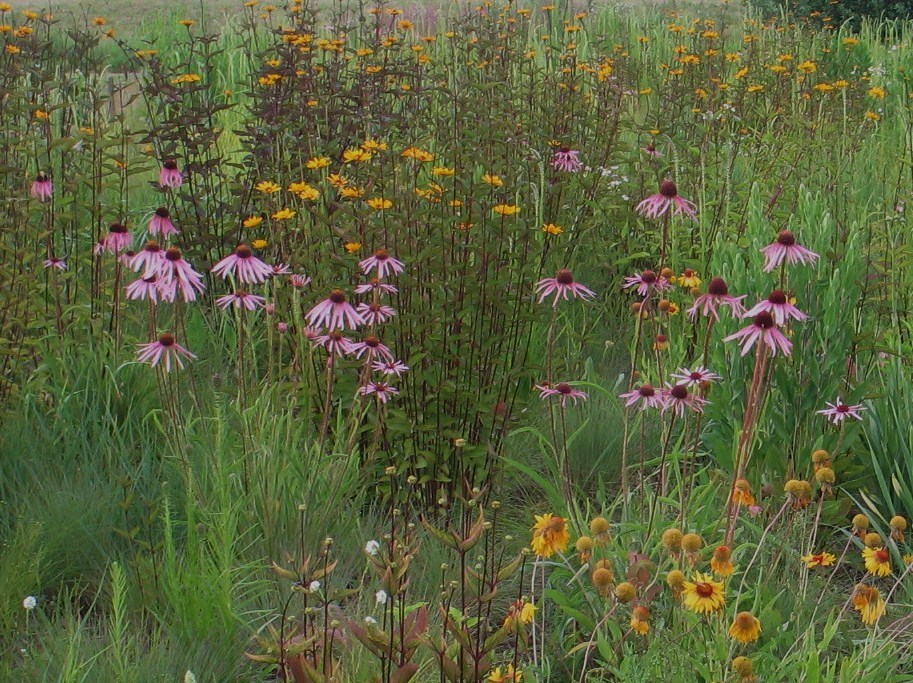
Echinacea pallida and Heliopsis helianthoides at the prairie in Alnarp

The Prairie at the Campus in Alnarp was planted in the end of October 2007. It has developed very well and just now the Pale Coneflower, Echinacea pallida flowers together with the oxeye, Heliopsis helianthoides ‘Summer Nights’, and some few still remaining flower heads of the Blanket flower, Gaillardia aristata. The real peak at the prairie is in late July and during August when thousands of Prairie Blazingstars are in bloom.

However we wanted to improve the flower display during early summer and last week we therefore arranged a planting day at the prairie. Helena Karlén, lecturer at the University in Alnarp, had planned the day and invited both some students and staff from the park to participate in the planting.

The following plants were planted last week: Echinacea pallida, Pale Coneflower, Liatris graminifolia, Grassleaf Blazingstar, Monarda fistulosa, Wild Bergamot, Silene regia, Royal Catchfly, Tradescantia ohiensis, Ohio Spiderwort and Bouteloua curtipendula, Sideoats Grama. The Baptisia australis, Blue Wild Indigo, didn´t germinate properly so we had only five plants to put into the ground.

The seeds were sown during the winter 

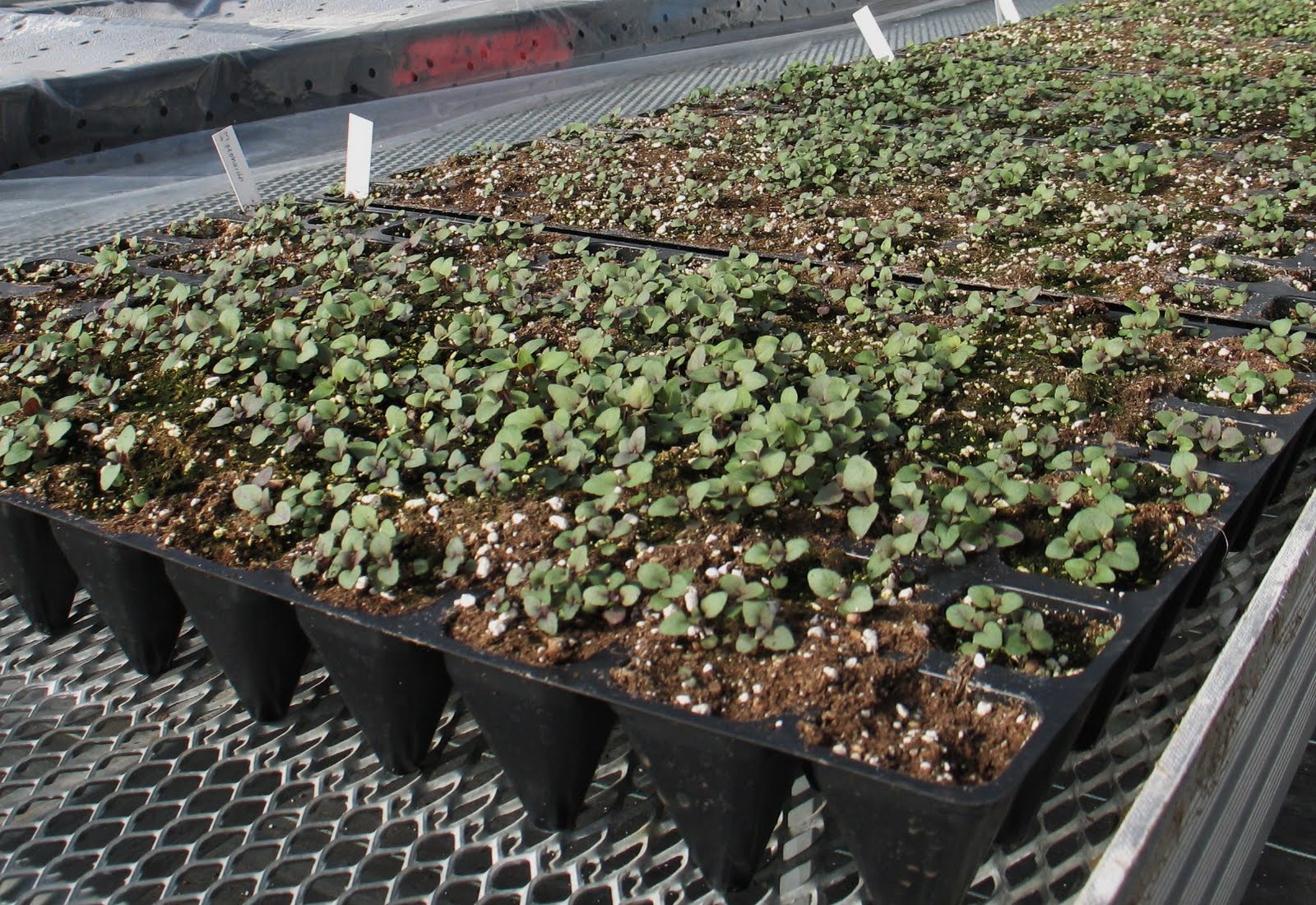
Seedlings of Monarda fistulosa

The plants growing at the Trädgårdslabbet in Alnarp

Time for planting

Planting the prairie - again

The day of planting, June 29th 2011

It is hard to find all pots in the tall grass

It was a hot day in late June just like a true Prairie Summer Day

Echinacera pallida at the prairie in Alnarp

The prairie in the beginning of July 2011

Echinacea, Heliopsis and Gaillardia

Thursday, 15 July 2010

Monarda for dry sites

Today I again visited Laholm and the famous citypark to discuss its continuing development. Later this year we are going to create a meadow for biodiversity and a planting beneath big beech trees with great spring aspects from bulbs and other early flowering perennials. Two amazing plantings for the future.

At the savanna in Laholm now the Wild Bergamot, Monarda fistulosa, recently has began to bloom. This Monarda is suitable for dry sites and tolerates water stress much better then the common garden cultivars. They belong all to the Monarda didyma-group or are hybrids between these two species. Monarda didyma prefer instead moist or even wet conditions.

The Pale Coneflower, Echinacea pallida, thrives well together with the Wild Bergamot