Saturday, 10 September 2011

Lurie Garden in Millennium Park


The Millennium Park in Chicago is a part of the extensive Grants Park situated between Lake Michigan and South Michigan Avenue. In Grants Park you will among other attractions find the Art Museum, the spectacular and famous Buckingham Fountain and in the very south of the park the Shedd Aquarium with a very wide range of aquatic animals including sharks, turtles and jellyfishes.

On my daughter’s birthday, July 16th 2004, the Millennium Park in the Northern part of Grants Park, was opened to public. Here you can visit the Lurie Garden made by Kathryn Gustafson, Piet Oudolf and Robert Israel.

It is a 20,000 m2 (5 acres) big garden divided into two different parts, the light plate and the dark plate, divided by a formal water channel and a broader pathway. Both sides are planted with perennials and are traversed by several walking paths. The perennial planting design is made by Piet Oudolf from the Netherlands. It is a kind of naturalistic planting although the plants are arranged in distinct blocks rather then spread naturally in a meadow like pattern.

Piet has used a mixture of plants from North America, Europe and Asia. The Salvia River known from Drömparken in Enköping in Sweden is here used in a bigger scale and its movement through the planting breaks the static planting blocks a bit in a very beneficial way.

When we visited the park in the end of July the Echinacea purpurea was blooming as best together with especially Hemerocallis and Allium senescens.

Saturday, 3 September 2011

Indian Boundary Prairies

Stuart Goldman, Prairie Restoration Specialist

Indian Boundary Prairies consist of four high-quality restored prairie remnants in Markham south of Chicago. Although the four prairies are situated close to each other they all look very different and also inhabit various plants and animals.

The Dropseed Prairie is the smallest, the Sundrop Prairie looks most remote and wild, the Painthbrush Prairie needs more restoration and the Gensburg-Markham Prairie has perhaps the most flagrant flower displays of them all. But they are all four worth the visit and they have all a lot of interesting prairie plants to discover.

At the Gensburg-Markham Prairie I met Mr. Stuart Goldman, restoration specialist and responsible for the maintenance of the prairies in Markham. He told me that when his boss started the renovation of the Gensburg-Markham Prairie it was just a waste land with trees and shrubs and not much left of the former prairie biotope.

Today they have converted the land back to a high-quality prairie with a diverse flora. The soil here is a mixture of black soil and sand and the conditions are more or less mesic, but with both dry and moist sections. One third of the prairie is burned every third year, normally during spring.

Among plants I found in bloom at the prairies in Markham I can mention Allium cernuum, Asclepias syriaca, Asclepias verticillata, Dalea candida, Dalea purpurea, Eryngium yuccifolium, Euphorbia corollata, Liatris spicata, Monarda fistulosa, Parthenium integrifolium, Phlox glaberrima, Pycnathemum virginianum, Ratibida pinnata, Rudbeckia hirta, Silphium integrifolium, Silphium laciniatum, Solidago juncea, Verbena hastata and Vernonia fasciculata.


Liatris spicata and Solidago juncea at the Gensburg-Markham Paririe

Stuart in action with instant weeding of invasive unwanted plants

Liatris spicata and Parthenium integrifolium at the Gensburg-Markham Prairie

Vernonia at the Sundrop Prairie

Smooth Ironweed, Vernonia fasciculata

Yellow Coneflower, Ratibida pinnata

Smooth Phlox, Phlox glaberrima

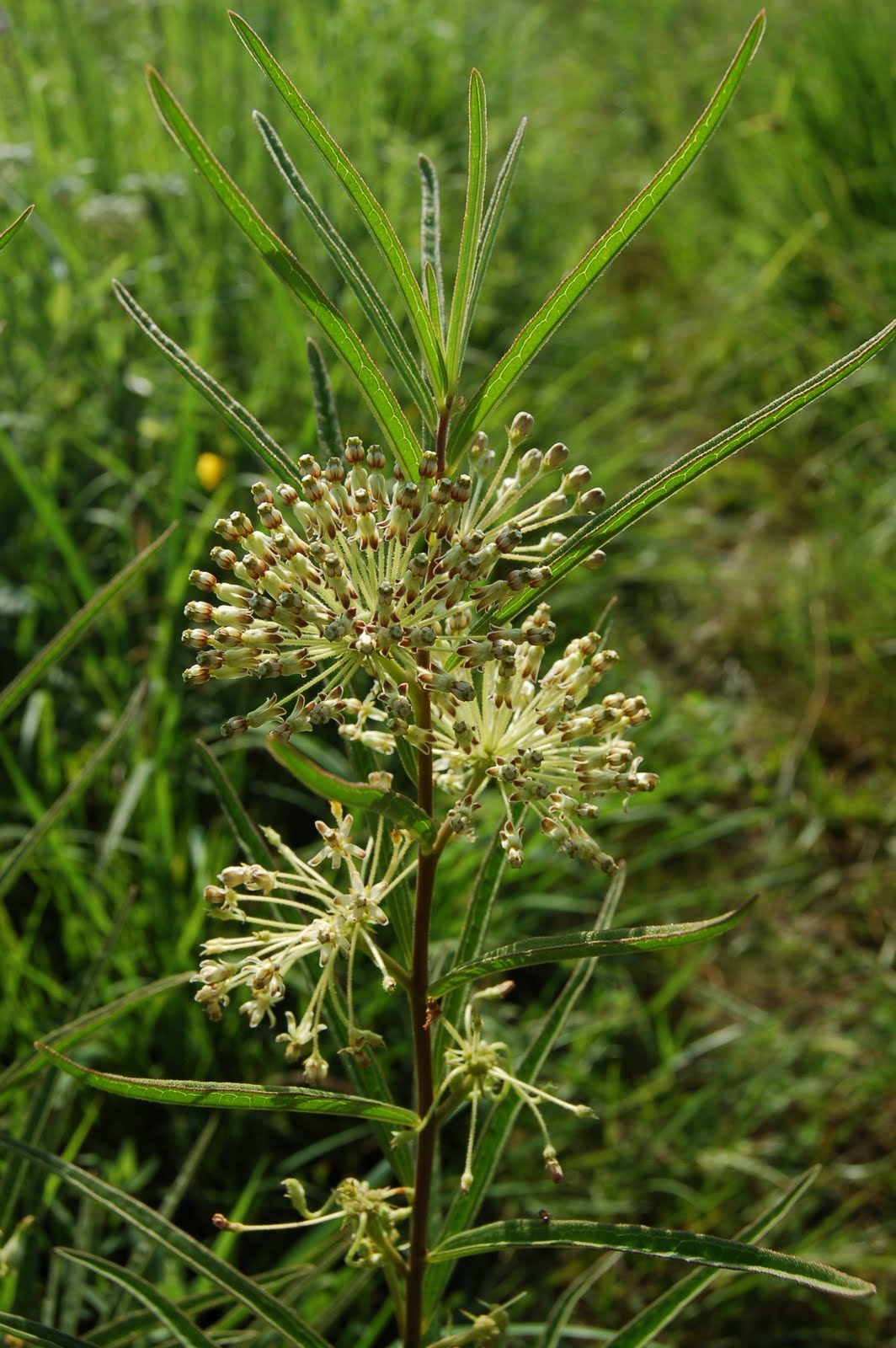
Worled Milkweed, Asclepias verticillata

White Prairie Clover, Dalea candida and Nodding Onion, Allium cernuum

Wild Bergamot, Monarda fistulosa at the Sundrop Prairie

Friday, 26 August 2011

The Prairie Junction in Mariestad


The Prairie in Mariestad will be growing on all four sides of a four-way junction when it becomes ready on a number of years. The first part was planted two years ago and is now beginning to gradually get established. We also sowed some seeds of certain species to get more dense vegetation. The pictures are from last weekend.

Echinacea, Agastache and Parthenium  


Aster pilosus, the Frost Aster

Wednesday, 24 August 2011

The Yellow Coneflower rules in Laholm

Yellow Coneflower, Ratibida pinnata, at the savanna in Laholm

Last weekend I first visited the plantings in the city park of Laholm and then continued to the Prairie Junction in Mariestad. That is a prairie planting we are making together with the garden students at the DaCapo School belonging to the University of Gothenburg. Today it is 1 500 sqm in size, but already next month we'll plant another additional 500 sqm.

Here are some pictures from the savanna in Laholm to start with. This time of the year there are many different species in bloom, but the dominating plants now are the Yellow Coneflower, Ratibida pinnata, and Coreopsis lanceolata.


Echinacea purpurea, Coreopsis and Ratibida


Saturday, 13 August 2011

Schulenberg Prairie


The Mallow poppy, Callirhoe involucrata, is a perennial plant with trailing branches covered by a cascade of glowing magenta pink cup shaped flowers. It prefer dry sites, and can be found along roadsides, on hill prairies, dry sand prairies and gravel prairies. Here it is planted at the entrance to Morton Arboretum in Chicago. 

We went for at three weeks long trip to the prairies in Illinois and Wisconsin and Morton Arboretum was one of our first stops. Unfortunately that particular day was the hottest on the entire journey with a temperature around 100° Fahrenheit (37-38° C). But still the famous Schulenberg Prairie just had to be visited. It was for sure worth the effort and the loss of 10 bottles of water.

Schulenberg Prairie is known to be one of the oldest planted prairies in the tallgrass prairie region. It is situated on west side of the arboretum and occur after a drive along some nice woodlands and and short walk through a small open savanna.    

Savanna landscape on the way to the Schulenberg Prairie

The Oak savanna with a understory of Eupatorium


White Prairie Clover, Dalea candida, and Culver's Root, Veronicastrum virginicum

The tall and very beautiful Pale Indian Plantain, Arnoglossum atriplicifolium

One among few still flowering specimen of Baptisia alba var macrophylla
 

Wild Bergamot, Monarda fistulosa

Rhus glabra close to the entrence to the Prairie Visitor Center

Oak leaf hydragea, Hydrangea quercifolia inside the park at Morton arboretum

Friday, 8 July 2011

Poppy seeds for the steppe


Today I spread the last seeds at the steppe roundabout in Lund. Most of the seeds are bought from Jellito Staudensamen in Germany and all arrived earlier this spring except for one item. Papaver croceum 'Wonderland Yellow' or Papaver nudicaule as it's also called, was a rest and came to my post box the other day.

First I mixed the seeds with Vermiculite in a bucket and then I walked around and throwed the mixture all around. I don't know if the poppy will germinate and establish at the calcareous steppe as I never tried it before under this conditions, but that is at least what I hope and expect. Many other seedlings are now emerging in the gravel and especially the Carthusian Pink, Dianthus carthusianorum and Chives, Allium schoenoprasum are abundant just as expected.


The two traffic islands are more densly planted then the roundabout itself.

Most plants are now settled and many tiny seedlings are visable in the gravel